Secrets to successful investing

Navigating stock market downturns


What’s happening?

Stock markets around the world have seen some sharp movements recently. This has largely been driven by events in the Middle East, including US and Israeli attacks on Iran and its allies, and retaliatory action by Iran. These developments have created some market reaction.

Geopolitical events like conflicts, elections, and tensions between countries can affect financial markets. They often lead to short‑term volatility, which means the value of your investments, including pensions, can move up or down quickly.

The important thing to remember is that these effects are usually temporary, and markets often recover. Investing is designed for the long term, which helps smooth out these short‑term ups and downs.

What to think about

The potential benefits of staying invested

When markets fall, it’s natural to feel concerned. But making sudden decisions can mean locking in losses. Staying invested can help because markets typically balance out over time. You may also benefit if they recover. Just remember, the value of investments can go down as well as up.

Investments tend to grow overall over longer periods. So, if you take your money when the value’s dropped, you may not get back what you originally paid in.

Focusing on the long term

Investing works best over the long term. It gives you time to ride out short term movements and avoid knee jerk decisions that may harm your returns.

This is especially true for pensions. When you're years away from retirement, you're likely to be investing more in shares. Shares carry more risk than other types of investment, but they have the best growth potential. As you get closer to retirement, you’re likely to favour lower-risk investments like bonds. This would mean the opportunity for growth might be lower, but so is the potential volatility.

Shares tend to perform well over time

Although past performance can’t predict the future, shares have historically delivered better long-term returns than most other types of investment, such as bonds or cash.

Shares can be more volatile, especially when there’s economic or political uncertainty, but they typically perform well when viewed over longer periods.

Diversification is key

Diversification, spreading your money across different types of investments, regions, and industries, helps reduce risk. Both our Ready-Made Investments and Ready-Made Pensions are already diversified, which can help spread your risk when things get bumpy.

What this might mean for you

News headlines can feel unsettling, but short‑term volatility is a normal part of investing. Markets have been through similar periods many times and usually adapt or recover quickly.
Reacting to every movement can introduce more risk and uncertainty into your own plan. Sticking to a long‑term approach helps you avoid decisions that could result in losses.

If you’re unsure what’s right for you, an independent financial adviser can help.
One last thought…

Successful investing takes discipline, patience and a clear view of your goals. By staying resilient during market dips, you give your investments the best chance to grow over time.

Please remember that the value of investments and the income from them can fall as well as rise, and you may get back less than you invest. Tax treatment depends on individual circumstances and may be subject to change in the future.

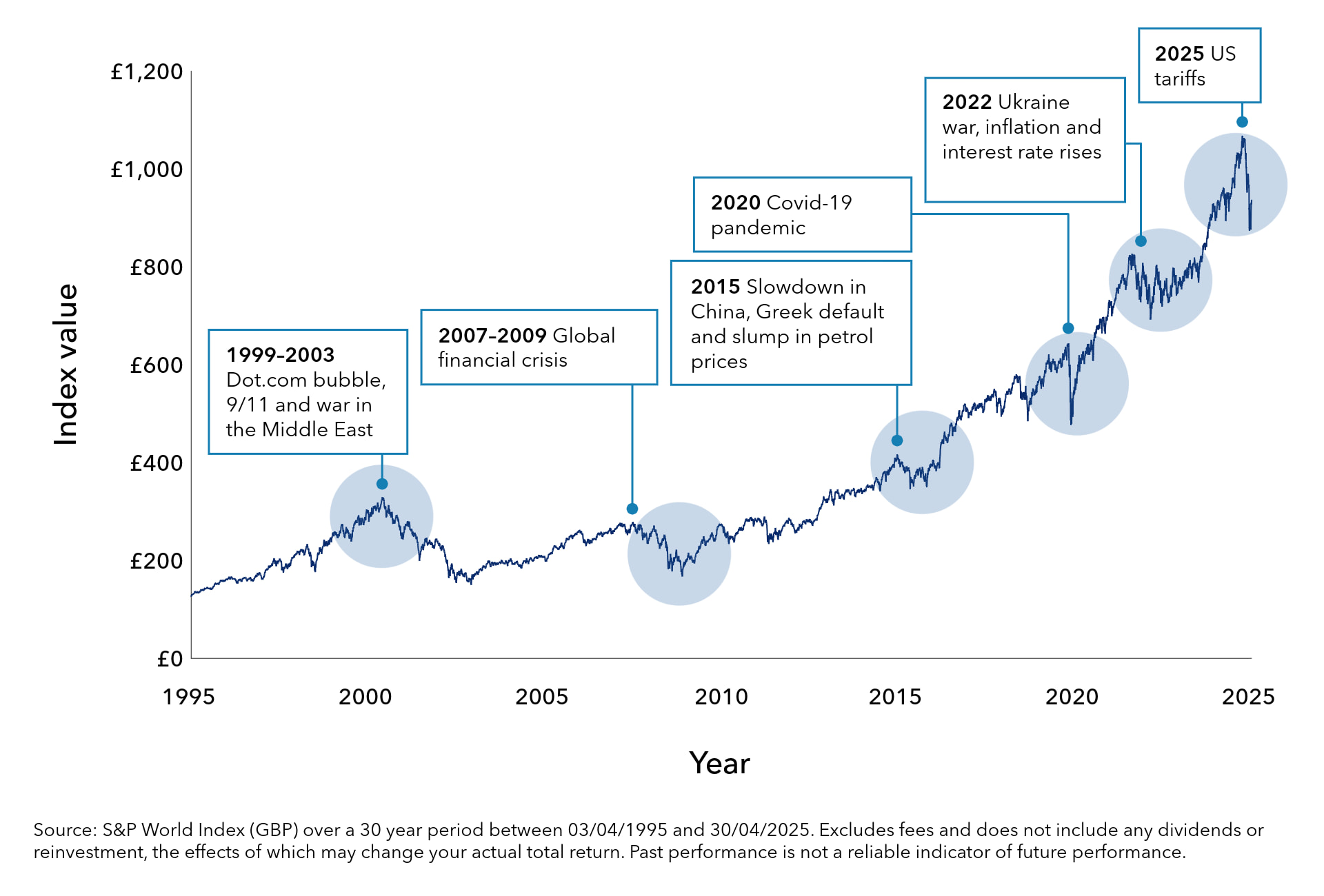
What UK market performance over the past 30 years shows us

The S&P World Index (GBP) shows long-term growth from 1995 to 2025, with several short-term declines caused by major world events.

Download the graph that shows the S&P World Index growth from 1995 to 2025 PDF(608KB)

  • This chart shows the S&P World Index (GBP) from 1995 to 2025. The index starts at about £125 in 1995 and ends just above £930 in 2025. Over these 30 years, the index generally rises, but there are several periods where it falls due to global events.

    Key events and their impact

    • 1999 to 2003: The index climbs quickly, then drops to around £200. This change is linked to the dot-com bubble, the 9/11 attacks and conflict in the Middle East.
    • 2007 to 2009: The global financial crisis causes the index to fall sharply after reaching about £400.
    • 2015: Growth slows but stays positive. This is due to a slowdown in China, the Greek debt crisis and lower petrol prices.
    • 2020: The Covid-19 pandemic leads to a clear dip after a period of steady growth.
    • 2022: The index moves up and down but keeps rising overall. This period includes the Ukraine war, higher inflation and rising interest rates.
    • 2025: The index peaks near £1,200, then drops below £1,000. This is linked to new US tariffs.

    Summary:

    The S&P World Index (GBP) shows long-term growth from 1995 to 2025, with several short-term declines caused by major world events.

Protecting your money

Protecting your money


The Financial Services Compensation Scheme (FSCS) protects the eligible money you hold with us.

More about the FSCS


The Financial Services Compensation Scheme (FSCS) protects the eligible money you hold with us.

More about the FSCS

You might also like

Risk explained

Understanding risk and reward is crucial to investing. Read our article to learn more.

Understanding risk

Research the market

Look for your next investment with our range of tools to find out more about Stocks, Funds, ETFs (Exchange Traded Funds) and Investment Trusts.

Research the market

New to investing?

We’ve created a simple five-step guide to help you decide if investing works for you.

Investing for beginners

Bank of Scotland Share Dealing Service is operated by Halifax Share Dealing Limited. Registered in England and Wales No. 3195646. Registered Office: Trinity Road, Halifax, West Yorkshire HX1 2RG. Authorised and regulated by the Financial Conduct Authority under registration number 183332. A Member of the London Stock Exchange and an HM Revenue & Customs Approved ISA Manager.